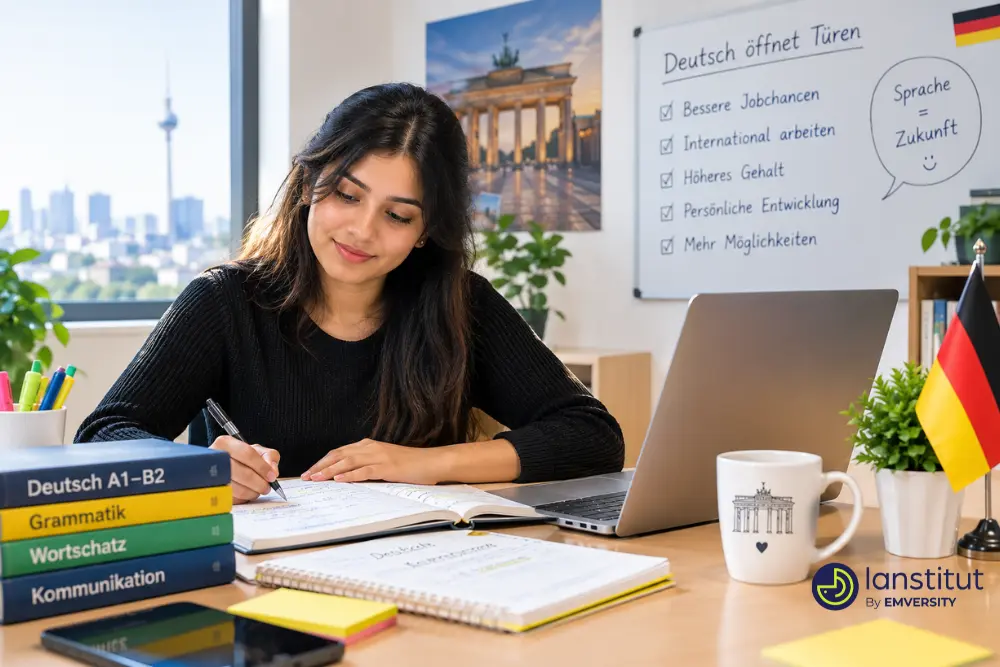
Learning a new language can be a worthwhile investment in both personal and professional growth. German, in particular, can open doors for people who want to study, train or build a career in Germany and other German-speaking regions.
But learning German is not only about adding a line to your CV. It can help you communicate with confidence, understand workplace culture and settle into daily life abroad.
If you are wondering whether it is worth your time and effort, understanding the benefits of learning German can help you decide.
Germany has a strong presence in engineering, healthcare, information technology, manufacturing, automobiles and research. Healthcare is a good example. Lanstitut's materials cite estimates that Germany could need 500,000+ nurses by 2030, with demand across hospitals, elderly care and surgical departments.
The level of German you need depends on your career path. Some roles operate largely in English, while others, especially patient-facing ones, require strong German.
The biggest advantage of learning German for career purposes is access to more employment options. It helps you handle professional situations more comfortably: understanding workplace instructions, speaking with colleagues, attending meetings, and handling administrative tasks.
It can also support different entry routes. The Germany Opportunity Card (Chancenkarte), for example, is a points-based route that lets qualified professionals from non-EU countries enter Germany and look for work without a job offer. The Institute says it allows a stay of up to 1 year and part-time work of up to 20 hours a week while you search, and language skills can count towards your eligibility.
German is an additional professional skill, not a guarantee of employment. Your qualifications, experience, profession and the employer's requirements all matter.
German is also valuable if your goal is education rather than immediate work. Students may consider Germany for university programmes and vocational training (Ausbildung), and language requirements vary by programme.
One example is the Ausbildung Seeker Visa. Lanstitut describes it as a route for candidates under 28 with Class XII and a B2 German certificate to travel to Germany and look for a vocational training place in person, across 150+ Ausbildung options in fields such as healthcare, hospitality, IT and logistics. It does not guarantee an offer.
Starting with A1 and progressing through A2, B1 and B2 gives you a structured way to build these skills.
A qualification may get you through the door, but communication is central to professional life. In healthcare especially, you need to follow hospital procedures, work with clinical documentation systems and explain things clearly to colleagues and patients.
With German, you may eventually be able to:
The higher your level, the more complex the conversations you can generally handle.
Another language shows commitment, adaptability and willingness to learn. Instead of writing "German – Basic", you can work towards a recognised level such as A1, A2, B1 or B2, backed by exams like TELC, Goethe.
Timing matters too. The institute notes that German language certificates are typically accepted for about one year in the Ausbildung process, so plan your exam around your application dates.
Language skills work best when paired with relevant qualifications and experience.
If you plan to work in Germany, learning the language early makes the transition easier. A typical path looks like this:
A1 → A2 → B1 → B2
A1 introduces basic German, A2 develops everyday communication, B1 supports more independent communication, and B2 provides stronger skills for complex and professional conversations.
Some professions have set requirements. For nurses, Lanstitut lists a recognised nursing qualification (GNM or B.Sc.), B2-level German and preferably 1 to 2 years of experience, followed by the Anerkennung (qualification recognition) process. Operation Theatre professionals with a BOTT degree, including freshers under 38, can also explore Germany-related pathways with Lanstitut.
Identify your career goal first, then decide how far you need to progress.
The advantage of learning German is not limited to the workplace. After arriving in Germany, you typically handle steps such as:
Handling these independently makes your transition more comfortable. Even if you work in an English-speaking environment, German is still useful outside work.
Learning a language takes patience. You listen, practise, make mistakes and try again. Over time, this helps you become more comfortable communicating with people from different backgrounds.
Regular speaking practice can help you stop avoiding conversations out of fear of mistakes. Among the benefits of learning German language skills, this confidence is one of the most lasting, because it goes beyond vocabulary and grammar.
German helps you connect with classmates, trainers, colleagues, employers, clients and professional communities. Communicating in the local language makes these interactions more natural and can help you build stronger relationships over time, which is a useful long-term advantage for students and young professionals.
Language and culture are closely linked. Studying German helps you understand how people communicate and express opinions, which matters if you will work with German speakers. The institute includes workplace and cultural orientation in its healthcare programmes for this reason. Speaking German doesn't mean you know the whole culture, but it helps you adapt.
A professional qualification prepares you for a particular role, while a language stays useful across your career. You might start learning German for a course or a job opportunity and later use it for workplace communication, further education or everyday life abroad.
No single level suits every career. Your target depends on your plans.
Requirements differ by course, employer and profession, so always check what applies to you.
Lanstitut, by Emversity, offers structured German language training for students and professionals who want to work in Germany. It has trained 10,100+ candidates and has 100+ experienced faculty members. According to Lanstitut:
Lanstitut has locations in Kochi, Domlur, Marathahalli, Calicut, Mangalore, Chennai, and Telangana, so you can explore options based on where you live.
If you want to know which level or format suits your plans, explore Lanstitut's German language training or contact the team to discuss your requirements.
The main benefits include better communication, access to education and career pathways, stronger international mobility, better workplace interaction and greater confidence when living or working in a German-speaking environment.
German can complement your qualifications, improve workplace communication, strengthen your CV and support pathways such as nursing, Ausbildung and the Opportunity Card. It does not guarantee a job, since qualifications, experience and employer requirements also matter.
It depends on the profession and pathway. A1 and A2 provide the foundation, while B1 and B2 support independent communication. The institute lists B2 for nursing and the Ausbildung Seeker Visa, so check the requirements for your own route.
German grammar and sentence structure may feel unfamiliar to English speakers, but it can be learned progressively. Starting at A1 and practising consistently makes it more manageable.
Yes. Beginners can start at A1 with no previous knowledge. A structured course introduces vocabulary, pronunciation, grammar and basic communication step by step.
Lanstitut prepares learners for TELC and Goethe exams, with guidance on exam slot booking and certification.
Lanstitut provides German training in Kochi, Domlur, Marathahalli, Calicut, Mangalore, Chennai, and Telangana, and you can view all Lanstitut training locations to choose a location or learning format that suits you.
The benefits of learning German language skills go beyond speaking an extra language. For students and professionals, German can support education plans, international career development and communication at work and in daily life in Germany.
Start by identifying your goals and choosing a programme that matches them. Whether you are a complete beginner at A1 or already know some German, consistent learning and regular speaking practice will help you progress.
If Germany is part of your plans, learning German is a skill worth starting today.