Germany attracts many physiotherapists looking to explore international career opportunities, gain professional experience, and work in a healthcare setting. For physiotherapists from India, learning German is an important part of preparing for this journey.
But one question often comes up before starting a German course: Do physiotherapists need B1 or B2 German to work in Germany?
The answer depends on your purpose and the requirements of the authority handling your application. However, for professional recognition as a physiotherapist, B2 German is commonly required. B1 can be a useful intermediate milestone on your learning journey, but you should not assume that B1 alone will be sufficient to obtain permission to practise.
In this guide, we explain the difference between B1 and B2, why German language skills matter in physiotherapy, what the recognition process involves, and how Indian physiotherapists can prepare for their language-learning journey.
Physiotherapy involves more than understanding medical terminology or following treatment instructions. Physiotherapists need to communicate with patients, understand their symptoms, explain exercises, discuss treatment plans, and monitor progress.
In Germany, this communication often takes place in German. Patients may describe pain in everyday language rather than medical terms. They may also ask questions about their treatment, mobility, recovery, or home exercises.
A physiotherapist needs to understand these conversations and explain information clearly.
German language skills are important for several reasons.
A physiotherapist may need to ask where a patient experiences pain, when the pain started, and which movements make it worse.
For example, understanding questions about pain, movement, and daily activities helps you gather information before planning treatment.
Patients need clear instructions about exercises, posture, movement, and recovery. A physiotherapist must be able to explain what to do, demonstrate movements, and check whether the patient has understood.
Healthcare professionals may need to read reports, understand instructions, document patient progress, and communicate with other members of a healthcare team.
German proficiency supports these responsibilities.
Patients may feel nervous, uncomfortable, or uncertain during treatment. Communicating in a language they understand helps physiotherapists explain procedures and respond to questions more effectively.
For these reasons, German is not simply an additional skill for physiotherapists planning to work in Germany. It is an important part of preparing for professional practice.
The Common European Framework of Reference for Languages (CEFR) describes language proficiency through levels ranging from A1 to C2.
B1 is an intermediate level, while B2 is an upper-intermediate level. Both represent useful stages of language development, but they support different levels of communication.
For physiotherapists planning to obtain professional recognition in Germany, B2 is commonly the relevant target. The exact requirements, including how and when language proficiency must be demonstrated, should be confirmed with the competent authority in the federal state where you intend to work.
At B1, learners can generally understand the main points of clear speech on familiar subjects, manage many everyday situations, and describe experiences or plans.
A B1 learner may be able to:
For a physiotherapist, B1 can help with everyday communication and provide a foundation for learning professional German.
However, healthcare communication can involve unfamiliar terminology, detailed patient descriptions, and complex instructions. These situations may require skills beyond those developed at B1.
B2 is an upper-intermediate level that develops greater independence in communication. Learners work towards understanding more complex information, explaining their opinions, following detailed discussions, and interacting with greater fluency.
At B2, you should be developing the ability to:
For physiotherapists, these skills are particularly relevant when discussing patient symptoms, explaining treatment options, and communicating with colleagues.
Feature
B1 German
B2 German
CEFR level
Intermediate
Upper intermediate
Everyday conversations
Can manage many familiar situations
Can communicate more independently across a wider range of situations
Listening
Understands the main points of clear speech on familiar topics
Can understand more complex information and discussions
Speaking
Describes experiences and gives simple explanations
Explains viewpoints and communicates in greater detail
Professional communication
Useful foundation for developing workplace language
Better suited to the more demanding communication expected at higher proficiency
Physiotherapy recognition
Do not assume B1 is sufficient
Commonly required for professional recognition
Recommended learning goal
A useful milestone on the way to B2
A practical target to plan for, subject to the relevant authority's requirements
The key takeaway is simple: B1 is an important step, but physiotherapists planning to practise in Germany should generally prepare for B2 and verify the exact requirements for their intended location.
Physiotherapy is a regulated profession in Germany. This means that a foreign-qualified physiotherapist generally needs professional recognition and permission to use the protected professional title before practising in the profession.
Official German government guidance commonly lists B2 German as the required language level for physiotherapist recognition. The responsible authority assesses the applicant's professional qualification and other relevant requirements.
For example, the German government's recognition information for physiotherapists in Baden-Württemberg and Berlin identifies B2 as the required level for the recognition process. Requirements and administrative procedures can vary by federal state.
Before applying, check the official recognition information for the German state where you plan to work.
Keep in mind that professional recognition and immigration are separate matters. A language level required for a particular visa or application step may not be the same as the level required to obtain professional authorisation.
Professional recognition is the process through which the responsible German authority assesses a foreign qualification against the requirements for the German profession.
For an Indian physiotherapist, this means that completing a BPT, MPT, or another relevant qualification does not automatically grant permission to practise in Germany.
The authority may review your education, training, professional experience, and other documents to determine whether your qualification meets the relevant requirements.
The process may involve several steps.
The recognition procedure depends on the German federal state where you intend to work.
Use the official German recognition portal to identify the relevant procedure and authority for your intended location.
You may be asked to submit documents such as:
The exact document list depends on your circumstances and the authority handling your application.
The authority assesses your professional qualification and compares it with the relevant German requirements.
If substantial differences are identified, additional measures, such as an adaptation course or knowledge examination, may be required. The outcome depends on the individual assessment.
You will need to demonstrate the required German proficiency according to the procedure that applies to you.
Some authorities may allow language evidence to be submitted at a later stage of the process. Do not assume that the same arrangement applies everywhere; confirm the timing and accepted certificates directly with the responsible office.
Professional recognition may involve requirements beyond language proficiency, including qualification equivalence, personal suitability, and medical fitness.
Reaching B2 is an important step, but it does not automatically guarantee professional recognition or employment.
For official information, start with the German government's Recognition in Germany portal.
Yes. Starting with B1 as an intermediate learning milestone can be a sensible approach, especially if you are beginning German from zero.
You do not need to master B2 material on your first day. Instead, build your language skills in stages.
A typical learning pathway is:
A1 → A2 → B1 → B2
At A1, you learn basic expressions, introductions, and simple sentence structures.
At A2, you develop your ability to communicate in everyday situations and discuss familiar topics.
At B1, you begin to communicate more independently, explain experiences, and understand the main points of clear conversations.
At B2, you work towards understanding more complex information, discussing different topics, and communicating with greater fluency.
The duration of each stage depends on your class schedule, independent practice, previous language-learning experience, and ability to use German regularly.
If your goal is professional recognition, plan your learning around the B2 requirement rather than stopping once you reach B1.
Reaching B2 requires consistent work across listening, speaking, reading, and writing. Learners should not rely only on grammar notes or vocabulary lists.
Here are some practical ways to prepare.
German grammar becomes more detailed as you progress through the levels.
Begin with sentence structure, personal pronouns, common verbs, articles, and basic cases. Later, learn more complex sentence patterns, connectors, and grammatical structures.
Instead of memorising rules without context, create your own sentences and use them in short conversations.
Listening can be challenging because spoken German may sound different from the sentences in your textbook.
Start with beginner-friendly recordings and gradually move towards longer conversations. Listen more than once, identify familiar expressions, and note new vocabulary.
As your level improves, include material about health, movement, exercise, and everyday workplace communication.
Many learners understand German better than they speak it. They may know the correct vocabulary but struggle to form sentences quickly.
Practise introducing yourself, describing your daily routine, explaining an activity, and answering questions aloud.
At higher levels, practise explaining opinions and summarising information. Ask a teacher or proficient speaker to correct mistakes that affect clarity.
Read texts suitable for your current level. As you progress, try longer articles, detailed instructions, and professional material that is appropriate for language learners.
Practise writing short paragraphs and emails. At B2, work on organising your ideas, supporting your opinions, and writing clear, structured responses.
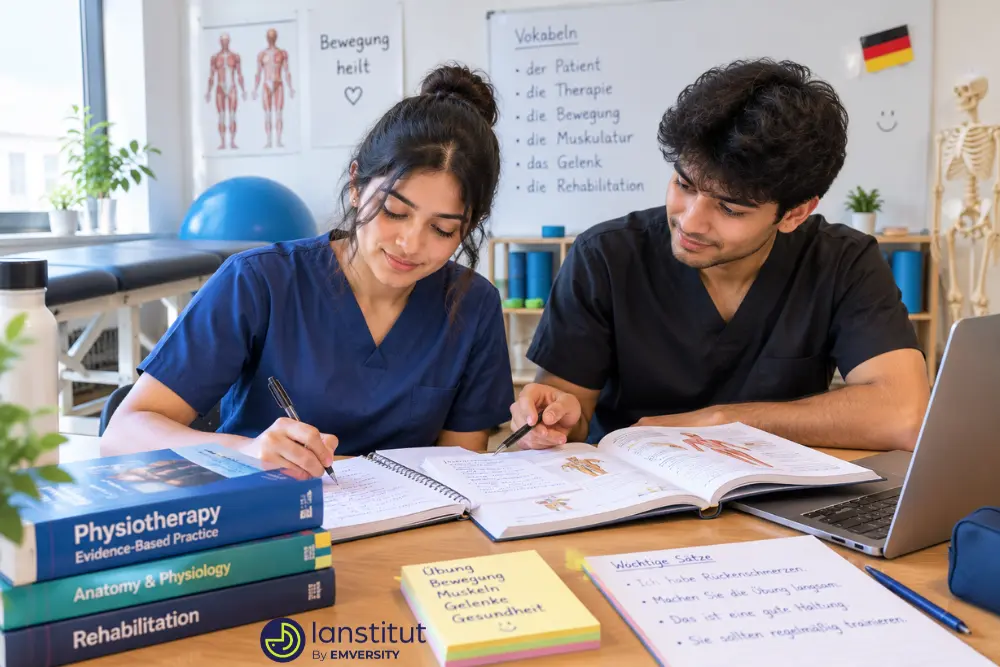
Alongside general German, begin learning vocabulary that is relevant to your professional background.
Examples include:
Learn how to use these words in complete sentences. For example, practise describing where a patient experiences pain or explaining a simple movement.
Remember that learning specialist vocabulary is not a replacement for achieving the general language level required by the relevant authority.
If you are working or studying while learning German, a realistic routine can help you maintain consistency.
Here is an example of a 45-minute practice session:
Activity
Time
Revise vocabulary from previous lessons
10 minutes
Practise grammar and sentence formation
10 minutes
Listen to German audio
10 minutes
Speak aloud or practise a conversation
10 minutes
Review mistakes or write a short paragraph
5 minutes
Adjust this routine according to your course schedule and current level. Beginners may need more time for pronunciation and grammar, while B1 and B2 learners may benefit from additional speaking, listening, and examination practice.
If you are preparing for a recognised B2 examination, include practice for all four skills and familiarise yourself with the format of your chosen examination.
B1 can help you build everyday communication skills, but it is not a safe assumption for professional recognition as a physiotherapist.
Check the language requirement with the authority responsible for your intended German state.
Knowing the German words for muscles, joints, and exercises is useful, but you also need general language skills to understand patients and communicate effectively.
Develop general German proficiency alongside professional vocabulary.
A language certificate can be important, but the ability to communicate in real situations also matters.
Use your study time to practise conversations, understand spoken information, and explain ideas clearly.
Moving quickly through a syllabus without revising previous topics can leave gaps in your language skills.
Make sure you understand the foundations before progressing to more complex material.
A B2 certificate does not automatically provide professional recognition, employment, or visa approval.
Your professional qualification, recognition outcome, employer requirements, and applicable immigration rules also matter.
If you are planning to work in Germany, choose a German language course that supports your starting level and long-term goal.
When comparing courses, consider these points:
If you are already a physiotherapist, you can also ask whether you can supplement general German lessons with healthcare-related vocabulary and communication exercises.
A course should help you develop your language skills, but the professional recognition decision remains with the relevant authority.
Lanstitut provides German language training for learners working towards different proficiency levels. If you are a physiotherapist planning to explore opportunities in Germany, structured German learning can help you build your skills step by step.
Before enrolling, ask the Lanstitut team about current A1–B2 course options, class schedules, learning modes, fees, and available examination preparation.
You can also explain your goal so that you can plan your language-learning pathway around the level you need to achieve.
Remember that Lanstitut is a language training institute, not a recruitment agency. Language training does not guarantee employment, placement, visa approval, or professional recognition. Those outcomes depend on the relevant authorities, employers, and individual eligibility requirements.
Ready to begin your German language journey? Contact Lanstitut to enquire about available German classes and plan your next learning step.
B2 is commonly required for professional recognition as a physiotherapist in Germany. B1 is a useful intermediate stage, but you should confirm the precise language requirements with the authority responsible for your intended federal state.
The timing of your language evidence and the requirements for the recognition process depend on the responsible authority. Some procedures may allow you to submit proof later, but you should not assume that B1 will satisfy the final language requirement. Check your individual procedure before applying.
Yes. Physiotherapy is a regulated profession. Foreign-qualified applicants generally need their qualifications assessed and must meet the requirements for permission to use the professional title and practise.
B2 may satisfy the language requirement in the applicable procedure, but it is only one part of professional recognition. Your qualification, any required compensatory measures, and other conditions must also be assessed and fulfilled.
Indian BPT graduates can explore the professional recognition process. Whether they qualify to practise depends on the assessment of their education and training, language proficiency, and other applicable requirements. A BPT degree does not automatically guarantee recognition.
Do not assume that an MPT is universally required or that holding one automatically ensures recognition. The competent authority assesses your individual qualification against the relevant requirements. Check the official recognition procedure for your intended location.
The time varies according to your starting level, class intensity, independent study, and practice opportunities. Ask your language provider for a realistic estimate based on its total learning hours and syllabus.
The accepted language evidence depends on the responsible authority and your individual procedure. Before registering for an examination, confirm which certificates and levels are accepted by the authority handling your application.
Yes. You can combine classes with regular independent practice. Create a manageable schedule for vocabulary revision, listening, speaking, grammar, and writing, and adjust your workload according to your responsibilities.
No. A course or certificate does not guarantee a job, professional recognition, placement, or visa approval. These depend on separate requirements, including professional qualification assessment, employer decisions, and applicable immigration rules.
For physiotherapists planning to work in Germany, the difference between B1 and B2 is important.
B1 helps you develop intermediate communication skills and is a valuable milestone in the learning journey. B2 is commonly the language target for professional recognition as a physiotherapist, although the exact procedure and accepted evidence should always be confirmed with the responsible authority.
Start with a strong foundation, practise consistently, and develop your listening, speaking, reading, and writing skills together. Alongside general German, build familiarity with vocabulary relevant to physiotherapy and patient communication.
Most importantly, plan your language learning around the official requirements for your intended destination. With a clear plan, you can work towards your German language goal while preparing the other documents and requirements needed for professional recognition.