
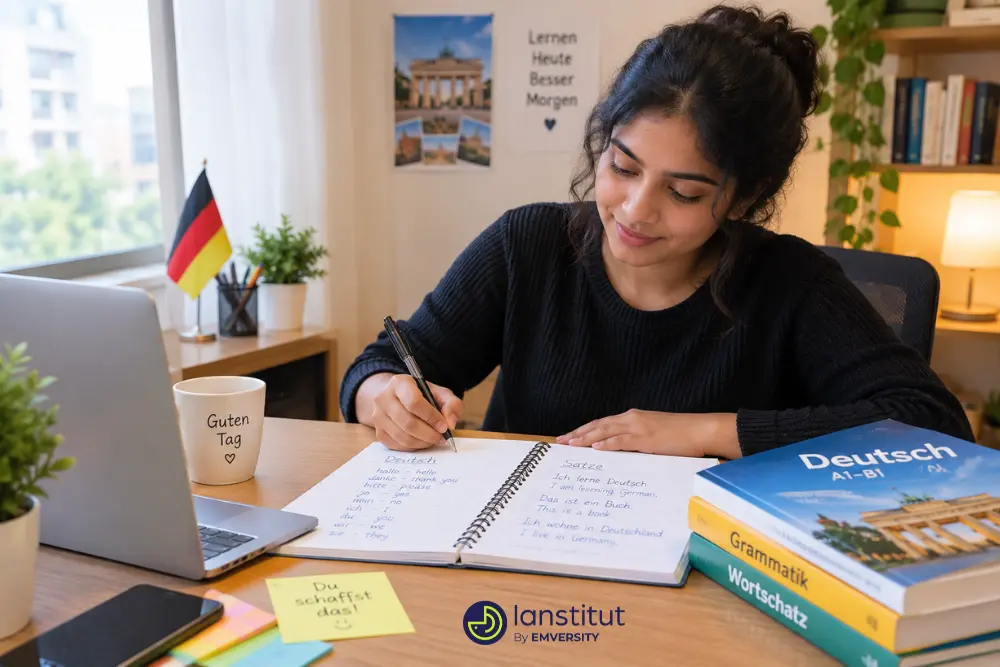
Learning German can feel difficult when you have a busy schedule. Between work, college, family responsibilities, and other daily activities, finding time to study a new language is not always easy.
Many learners start learning German with great enthusiasm. They attend classes, buy books, download language-learning apps, and make plans to study every day. But after a few weeks, their busy schedules take over, and regular practice becomes difficult.
Does this mean you cannot learn German if you have no free time?
Not at all.
You do not need several hours every day to practise German. You need a simple routine that fits into your daily life. Even 10–20 minutes of focused practice can help you stay connected to the language and gradually improve your vocabulary, listening, speaking, reading, and writing skills.
Whether you are learning German for higher education, Ausbildung, healthcare jobs, career opportunities, or a Goethe or TELC exam, small daily habits can make your learning journey more manageable.
In this guide, let us explore practical ways to practise German every day, even when you have a busy schedule.
Learning German is not just about attending classes or completing grammar exercises. You also need to use the language regularly.
When you learn a new word today but do not use it again for several weeks, you may forget it. When you practise speaking regularly, you become more familiar with sentence structures and gradually feel more comfortable expressing yourself.
Daily practice helps you:
You do not need to learn something new every single day. Sometimes, revising what you already know is just as useful.
The goal is to make German a regular part of your life instead of treating it as a subject you study only when you have free time.
One of the biggest mistakes German learners make is creating an unrealistic study timetable.
For example, you might decide to study German for two hours every evening. However, after a long day at work or college, you may feel too tired to follow that plan.
Instead, start with 10 minutes.
You can divide those 10 minutes into three simple activities:
This small routine is easier to follow even on busy days.
Once you become comfortable, you can increase your practice time whenever your schedule allows.
Remember, the aim is not to complete a large amount of work every day. It is to avoid losing touch with the language.
You do not always need to sit at a desk to learn new German words.
You can use small gaps in your day to revise vocabulary.
For example, while waiting for a bus, standing in a queue, or taking a short break at work, revise a few words using flashcards or your notebook.
Start with words related to your everyday life.
English
German
Water
das Wasser
Food
das Essen
Work
die Arbeit
House
das Haus
Friend
der Freund / die Freundin
Today
heute
Tomorrow
morgen
To learn
lernen
To speak
sprechen
To understand
verstehen
Do not stop at memorising the English meaning. Try to use each word in a sentence.
For example:
This helps you understand how German words work in real sentences.
A useful tip: Learn a few words that you can actually use instead of trying to memorise 30 or 40 words at once.
Do you spend time travelling to work, college, or other places?
You can use part of that time to improve your German listening skills, provided it is safe to do so.
Listen to beginner-friendly German audio, short conversations, or learning podcasts. If you are travelling by public transport, you can listen with headphones. Never use your phone or headphones in a way that distracts you while driving or crossing roads.
At the beginning, you may understand only a few words. That is completely normal.
Try this simple method:
You do not have to understand every word to benefit from listening.
As your vocabulary grows, familiar words and sentence patterns will become easier to recognise.
If you are at A1 or A2, choose slow, clear German conversations about topics such as introductions, family, shopping, food, travel, and daily routines.
Learners at B1 or B2 can gradually move towards longer conversations, interviews, news summaries, and content about work or education.
Choose material that matches your level. If every sentence feels impossible to understand, start with something simpler.
Many learners understand German grammar but struggle when they need to speak.
This often happens because they spend more time reading and writing than actually speaking.
The good news is that you do not always need a speaking partner.
You can practise German alone for five minutes a day.
Start by describing what you are doing.
For example:
You can also describe the objects around you.
If you see a book, say, "Das ist ein Buch." If you are drinking tea, say, "Ich trinke Tee."
These sentences may seem simple, but they help you practise thinking in German.
Choose one topic and speak about it for one minute.
Topics can include:
Do not stop every time you make a mistake. Finish your thought first, then review the sentences you found difficult.
As you improve, try speaking for two or three minutes without reading from a script.
Most people check their phones several times a day.
You can turn a small part of that screen time into language practice.
For example, you could:
Some learners also find it helpful to change selected app settings or their phone language to German. However, complete beginners may find this confusing, so it is better to make small changes gradually.
You do not need to install many applications. Choose one or two resources that you find easy to use and follow them consistently.
The important thing is to practise actively rather than scrolling through German content without paying attention.
Instead of memorising individual words all the time, learn one complete sentence each day.
Sentences help you understand vocabulary, grammar, and word order together.
For example:
Monday: Ich lerne Deutsch.
I am learning German.
Tuesday: Ich trinke jeden Morgen Kaffee.
I drink coffee every morning.
Wednesday: Ich gehe heute zur Schule.
I am going to school today.
Thursday: Ich möchte Deutsch sprechen.
I would like to speak German.
Friday: Ich habe heute viel Arbeit.
I have a lot of work today.
Saturday: Am Wochenende treffe ich meine Freunde.
I meet my friends on the weekend.
Sunday: Ich wiederhole, was ich gelernt habe.
I revise what I have learned.
Read the sentence, understand its meaning, and say it aloud several times.
Then try changing one part of the sentence.
For example:
This helps you create new sentences instead of memorising only one fixed example.
German grammar can feel challenging, especially when you start learning articles, cases, verb conjugations, and sentence structure.
But you do not need to study every grammar topic in one sitting.
Choose one small topic and practise it for five to ten minutes.
For example:
This is only a sample timetable. Follow the sequence that matches your current course level.
For A1 learners, it is useful to build a strong foundation before moving into more advanced grammar. For B1 and B2 learners, short revision sessions can help reinforce complex sentence structures and improve accuracy.
Do not try to master an entire grammar chapter in one day. Learn a small concept, use it in sentences, and revisit it later.
One simple way to practise German is to describe familiar activities in your mind.
When you wake up, think about how you would describe your morning in German.
For example:
You can practise the same way while cooking, cleaning, shopping, or preparing for college.
At first, you may need to look up words. That is fine.
Write down unfamiliar words and revise them later.
This activity helps connect German with real-life situations, making it easier to recall words when you need them.
Reading does not always mean sitting down with a textbook.
You can read a short paragraph, a simple story, a dialogue, or a few sentences from your learning material.
Choose content that is appropriate for your level.
For beginners, try reading:
Intermediate learners can read short articles, emails, news summaries, or texts related to their interests.
When you read, follow these steps:
This method builds reading confidence and helps you recognise familiar vocabulary in different contexts.
Writing is another skill that busy learners often ignore.
You may practise speaking and listening but still struggle to write an email or answer an exam question.
You can improve this by writing three simple sentences every evening.
For example:
You can also keep a small German diary.
Write about your day, your plans, or something interesting that happened.
At the beginning, do not worry about writing long paragraphs. Focus on making clear sentences with the grammar you already know.
As you progress, gradually include connectors, reasons, opinions, and more detailed descriptions.
If possible, ask your teacher to correct your writing so you can understand recurring mistakes.
Sometimes learners feel that progress means completing a new chapter every day.
However, learning something once does not mean you will remember it permanently.
Revision is an important part of language learning.
For example, if you learned German articles last week, spend a few minutes reviewing them today. If you studied modal verbs earlier, create three sentences using them.
A simple revision method is:
You can use a notebook, flashcards, or short quizzes to track what you remember.
Regular revision helps you identify weak areas before they become bigger problems.
You may not have enough time for a long study session during weekdays.
That is fine. Use weekends to practise the topics you could not cover during the week.
For example, spend 30–45 minutes on Saturday or Sunday doing a combination of activities:
You can also watch a beginner-friendly German video with subtitles.
The purpose of weekend practice is not to compensate for every minute you missed. It is to reinforce your learning and prepare for the next week.
If you often say, "I do not have time to study German," try following a fixed routine.
Here is a sample plan you can adjust to your level.
Time
Activity
Purpose
3 minutes
Revise five words
Build vocabulary
4 minutes
Listen to German audio
Improve listening
4 minutes
Speak aloud
Build confidence
2 minutes
Read a few sentences
Improve reading
2 minutes
Write one or two sentences
Practise writing
Total: 15 minutes.
On days when you have more time, you can extend the session or attend a class. On particularly busy days, complete a shorter version rather than abandoning the habit entirely.
Consistency matters, but your routine should remain flexible enough to fit your real life.
Your practice routine should change as your German improves.
At A1, focus on:
Practise introducing yourself and describing familiar things.
At A2, practise:
Try speaking in complete sentences instead of giving only one-word answers.
At B1, focus on:
Try speaking about a topic for two or three minutes without preparing every sentence in advance.
At B2, practise:
You can also practise timed exercises if you are preparing for a Goethe or TELC exam.
The key is to choose activities that match your current level rather than repeating only beginner exercises.
Your reason for learning German can help you decide what to practise.
Practise introductions, patient-related vocabulary, instructions, everyday conversations, and listening comprehension relevant to your training.
Remember that language preparation is only one part of the process for working in healthcare abroad.
Focus on introducing yourself, discussing your interests, understanding instructions, and talking about your education and career goals.
Practise reading, listening, academic vocabulary, structured writing, and speaking about your chosen subject.
Make sure your daily routine includes activities related to the exam's reading, listening, writing, and speaking sections.
The exact exercises should match your target level and exam format.
When your practice is connected to your goal, it becomes easier to stay motivated.
Even a short daily routine can be useful, but some habits may slow your progress.
Mistake 1: Only memorising vocabulary
Learn words in sentences and use them in conversation.
Mistake 2: Avoiding speaking because of mistakes
Mistakes are part of learning. Practise regularly and work on corrections over time.
Mistake 3: Watching German videos without active listening
Pause, repeat sentences, and note useful expressions rather than watching passively.
Mistake 4: Studying different topics randomly
Follow a simple plan that matches your level and course.
Mistake 5: Comparing your progress with others
Every learner has a different schedule, starting point, and learning pace.
Mistake 6: Giving up after missing one day
If you miss a day, start again the next day. You do not need to wait until Monday or the beginning of a new month.
Self-study is useful, but some learners find it difficult to stay consistent without guidance.
A structured German course can help you follow a learning plan, understand grammar, practise speaking, and identify mistakes.
A good learning routine should include:
For working professionals and students, online classes and recorded lessons can provide additional flexibility, depending on the course arrangements.
However, recorded lessons should not completely replace active speaking practice and feedback.
If you are preparing for a German exam or planning to use German for your career, choose a course that supports your current level and long-term goal.
At Lanstitut, learners can explore German language training from beginner to higher levels, depending on their learning needs and available course options.
For students and working professionals with busy schedules, the important thing is to combine structured learning with regular practice outside class.
You can make better use of your learning time by:
Whether your goal is to prepare for a German proficiency exam, pursue higher education, explore Ausbildung, or build language skills for your career, a consistent routine can help you make steady progress.
If you are unsure how to organise your study time, seek guidance on choosing a suitable learning plan for your level and schedule.
Yes. Fifteen minutes of focused practice can help you maintain a routine and improve gradually. Your overall progress will depend on your starting level, practice quality, course participation, and total learning time.
Speak aloud, describe your daily activities, read short texts aloud, record yourself, and practise answering simple questions. You can also use teacher-led speaking sessions when available.
The best time is the time you can follow consistently. Some people prefer practising in the morning, while others use their commute or evening breaks. Choose a routine that fits your schedule.
Listen to short, level-appropriate German audio during suitable breaks or while travelling safely. Repeat familiar clips, identify key words, and gradually move to longer conversations.
You do not need to study a new grammar topic every day. Short revision sessions and practising grammar through sentences can be effective ways to reinforce what you learn in class.
Revise words regularly, use flashcards, create example sentences, and try using new vocabulary while speaking or writing. Revisiting words over time can help strengthen recall.
It is possible to prepare while working, but you need a realistic timetable. Combine short daily practice sessions with structured lessons, regular revision, and exam-specific exercises.
Online learning may be suitable for busy professionals because it can offer more scheduling flexibility. Look for a course that also includes speaking opportunities, feedback, and a clear learning structure.
Simply restart with a short session. Review familiar words or listen to a short conversation before returning to your normal routine. Avoid trying to complete everything you missed in one sitting.
Regular practice is valuable because it keeps you engaged with the language. Longer, structured study sessions are also important for learning new concepts and preparing for exams. A balanced routine that includes both is often more practical.
You do not need a completely free schedule to practise German. You need a realistic plan that works with the time you already have.
Start with 10–15 minutes a day. Revise a few words, listen to a short conversation, speak aloud, or write a few sentences before bed.
Use your daily activities as opportunities to practise. Choose learning materials that match your level, revise regularly, and focus on the skills you need for your personal goals.
Most importantly, do not wait for the perfect time to start.
A few minutes of focused German practice today can help you build a habit that supports your learning over time.
If you want to learn German with a clear structure and guidance, explore the available German courses at Lanstitut and find a learning plan that suits your schedule and goals.