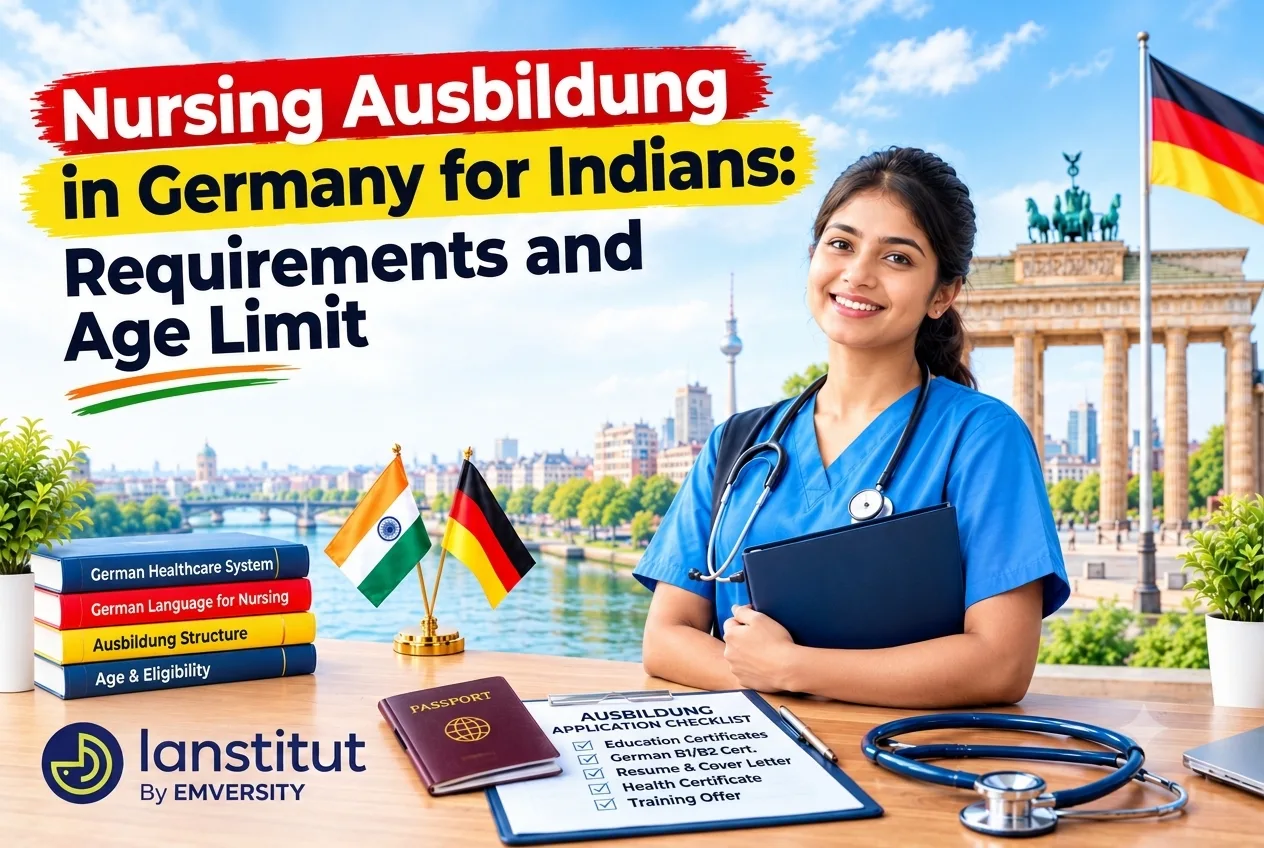
If you have finished Class 12 and dream of a nursing career abroad, you have probably heard the word "Ausbildung" by now. Maybe a cousin mentioned it, or a reel popped up on your feed. The idea sounds almost too good to be true: learn a profession in Germany, get paid every month, and pay no tuition fees. But before you get excited, you need clear answers. Who can apply? What is the age limit? Which documents do you need?
Here is a simple, step-by-step look at nursing Ausbildung in Germany for Indian students: who can apply, the age limit, the documents you need, and what to expect along the way.
Ausbildung is Germany's structured vocational training programme. You learn a profession while working with an employer, and you earn a monthly training allowance from day one. The employer covers the training costs, so there are no tuition fees. There are 325+ officially recognised Ausbildung professions in Germany, and nursing is one of the most in demand.
In nursing, this means a three-year dual training that combines clinical training at a hospital or care facility with classes at a vocational school (Berufsschule). Depending on the employer and school, this runs as weekly days (often 2 to 3 days of clinical training and 1 to 2 days at school) or in alternating blocks, so you are never only sitting in a classroom. When you finish, you hold the state-recognised Pflegefachfrau/Pflegefachmann (registered nurse) qualification, and nurses are needed across hospitals, rehabilitation centres, nursing homes and home care services.
The good news is that the basic Ausbildung in Germany requirements are quite simple. Employers mainly look at four things:
The paperwork is where many students lose time, so here is the full list of documents under the Ausbildung in Germany requirements:
A small tip: start with the passport and police clearance early. They are easy to forget, and slow to fix when a deadline is close.
Let's answer the question that worries most people. Germany has no legal upper age limit for Ausbildung, but most employers prefer candidates between 18 and 28, so that is the practical Ausbildung in Germany age limit. So if you are 19 or 24, you are in a comfortable spot. If you are close to 30, don't wait too long. Applications take months, and your B2 must be finished first.
What if you are older than 30, or you already hold a GNM or B.Sc Nursing degree? Then Ausbildung may not be your best route. Qualified nurses usually follow the recognition (Anerkennung) pathway instead. It needs a recognised nursing qualification, German at B2 level, and ideally one to two years of experience. The German authority assesses your qualification, and if there are gaps, you complete an adaptation course or a knowledge examination. During this period, salaries are approximately €2,200 to €2,600 per month, and after full recognition around €2,800 to €3,500.
Not sure which path fits you? That is exactly what a profile assessment is for.
For nursing, most German employers expect a B2 certificate, so this is where your journey really starts. Many students feel stuck at this point, and honestly, that is completely normal.
At Lanstitut, our A1 to B2 programme is built for healthcare aspirants. Classes are fully online, Monday to Saturday, so you can learn from wherever you are. Each level takes about 2.5 months, and the full programme runs for around 10 months in online and 6.5 to 7.5 months in offline, with mentor support. Internal exams every second week track your progress, and regular practice sessions keep you exam-ready. Over 10,100 candidates have trained with us, and our focus is on speaking German in real workplace situations, not only clearing an exam.
Here is how the journey usually unfolds:
The August/September intake is the main one, with the highest number of seats, so apply 6 to 9 months in advance (October to January). The February/March intake has limited seats, and applications usually run from August to October of the previous year. Also budget for costs in India: German classes, document translations, the visa fee (about €75) and your flight. Be cautious of agents who promise guaranteed jobs or ask for large upfront fees; a genuine German employer never charges you for a training contract.
Your monthly training allowance (Ausbildungsvergütung) is paid gross and grows each year (rupee values at approx. ₹103 per euro):
The exact amount may vary by employer. Many employers provide accommodation or help you find housing. If not, typical rent in smaller towns is around €400 to €700 per month (roughly ₹41,000 to ₹72,000). Whatever the offer, read your training contract carefully before signing.
Once you complete nursing Ausbildung in Germany, you hold a German-recognised qualification and get the opportunity for permanent employment with a full professional salary package. You may also become eligible to apply for permanent residency (under current rules, usually after about two years of skilled employment) and, later, German citizenship. Family reunification may be available too. All of this depends on German law, employer policies and your individual eligibility, so always check the latest rules.
Yes. Class 12 or above, with formal secondary schooling completed, is the basic education requirement. You also need B2 German, and all B2 modules must be completed before your application begins. Along with this, keep your passport, academic certificates, Europass CV and a personalised motivation letter ready.
There are no tuition fees, because the employer covers the training costs. On top of that, you earn a monthly training allowance from day one, starting at €1,341 in year one and rising to €1,503 in year three. You will still have personal expenses such as rent, which is typically €400 to €700 in smaller towns if accommodation is not provided, so go through your contract carefully.
The employer interview is online, in German or a mix of German and English. Your profile is reviewed first, and you receive interview preparation that includes mock interviews, German practice and video interview guidance. If you are selected, you receive your Ausbildungsvertrag (training contract).
There is no legal upper age limit, but most employers prefer candidates between 18 and 28, which is why it is seen as the practical Ausbildung in Germany age limit. Staying within it gives you the best chance. If you are older, or you already hold a GNM or B.Sc Nursing degree, the recognition (Anerkennung) pathway is often more suitable, since it is designed for qualified nurses. A counsellor can look at your profile and suggest the right route.
It depends on where you start. The employer interview and admission stage takes around 2 to 3 months, and visa processing usually takes 6 to 12 weeks. If you are beginning German from A1, the full A1 to B2 programme runs for about 10 months. For the main August/September intake, applications should go in 6 to 9 months in advance, so starting early gives you breathing room.
Your arrival is coordinated with your employer. Within 14 days you need to register your address, and you should also open a German bank account. Many employers provide accommodation or help you find suitable housing, which makes the first weeks much easier.
After completing your training, you hold a German-recognised qualification and have the opportunity for permanent employment. You may also become eligible to apply for permanent residency (usually after about two years of skilled employment under current rules) and German citizenship, and family reunification may be available. All of this is subject to German law, employer policies and your individual eligibility.
We prepare you for the whole journey: online German classes from A1 to B2, mock interviews and video interview guidance, help with your documents, and direct connections with employers in Germany. The aim is simple: to make you workplace-ready, not just exam-ready.
Planning Ausbildung in Germany for Indian students like you is a big decision, and you don't have to figure it out alone. At Lanstitut, we guide you from German language training to interviews, documents and visa preparation.
Visit Lanstitut to start your nursing Ausbildung journey today.