
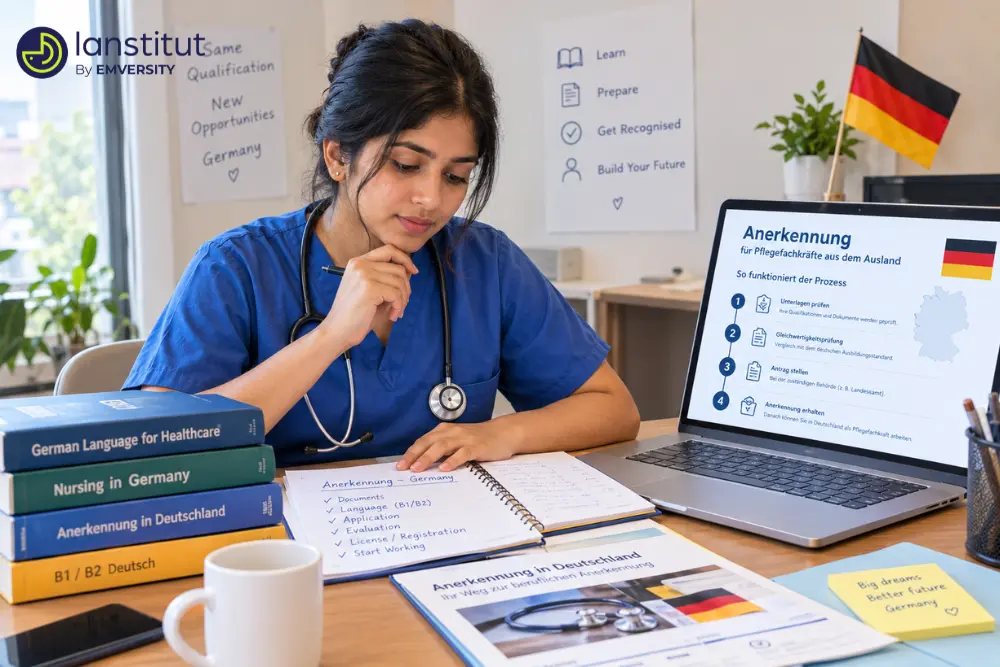
If you are a nurse from Kerala planning to work in Germany, you will probably come across one important German word: Anerkennung.
You may hear people say that you need Anerkennung before working as a nurse in Germany. But what does it actually mean? Is it an examination? Is it a certificate? Do B.Sc Nursing and GNM graduates follow the same process? Can you apply while staying in India?
These are common questions among Indian nursing graduates who are planning their future in Germany.
In simple words, Anerkennung means official recognition of your foreign nursing qualification by the relevant German authority. The authority checks whether your nursing education and training meet the German professional requirements.
It is an important step because nursing is a regulated profession in Germany. You generally need professional recognition and permission to use the protected nursing professional title before working as a fully authorised nurse.
This guide explains the Anerkennung process step by step, using simple language for nurses from Kerala and other parts of India.
Anerkennung is the German word for recognition.
When you complete B.Sc Nursing or GNM in India, you receive a qualification that allows you to pursue nursing opportunities under the applicable Indian rules.
However, Germany has its own nursing education system and professional standards. The German authorities need to check whether your foreign qualification is comparable to the German nursing qualification.
The German reference profession is known as:
Pflegefachfrau / Pflegefachmann / Pflegefachperson
When you apply for Anerkennung, the responsible authority reviews your educational background and training to determine whether your qualification meets the required standards.
The process may involve checking:
The authority then issues an official decision explaining the outcome of your application.
You can read about the process on the official German government website:
Recognition in Germany – Official Portal
Nursing is a regulated profession in Germany. This means you cannot simply travel to Germany with an Indian nursing certificate and start working independently as a fully recognised nurse.
You must meet the relevant professional requirements.
Anerkennung helps the German authority determine whether your Indian nursing education is equivalent to the German reference qualification.
Without the required professional authorisation, you cannot use the protected professional title or practise as a fully authorised nurse.
For nurses from Kerala, this process is particularly important because Indian nursing qualifications may have different course structures and training arrangements compared with German nursing education.
The recognition process helps identify whether your qualification meets the German requirements or whether you need additional training or an assessment.
Yes. Nurses with Indian B.Sc Nursing and GNM qualifications can explore the German recognition process.
However, the recognition authority assesses each qualification individually.
B.Sc Nursing is a bachelor's degree programme that typically includes four years of academic and clinical education in India.
If you have completed B.Sc Nursing, the German authority will examine your educational records, course content, and practical training.
Your degree does not automatically guarantee full recognition. The authority may identify differences between your education and the German nursing qualification.
GNM is a diploma-level nursing qualification that combines theoretical education with clinical training.
GNM graduates can also investigate recognition opportunities in Germany. The authority will assess the qualification and supporting documents to determine whether the training meets the required standards.
No. A bachelor's degree does not automatically guarantee recognition in Germany.
Similarly, GNM graduates should not assume that their qualification will automatically be rejected.
The final decision depends on the individual assessment and applicable requirements.
The process may seem complicated when you first hear about it, but it becomes easier to understand when divided into steps.
Here is a simple overview for Indian nurses.
Germany has 16 federal states, known as Bundesländer.
Examples include:
The authority responsible for nursing recognition depends on the state where you intend to work.
Therefore, you should first identify your intended destination and find the responsible recognition authority.
You can use the official Recognition Finder to identify the relevant authority.
The next step is to prepare the documents required for your application.
For nurses from Kerala, commonly requested documents may include:
The exact document list depends on the authority and your individual situation.
Some documents may need certified copies or official German translations. Always check the authority's instructions before arranging translations.
After preparing the required documents, submit your recognition application to the responsible German authority.
Depending on the state, you may be able to apply online or through another specified application method.
You do not necessarily have to travel to Germany just to begin the recognition process. Applications from abroad are possible under the relevant procedures.
This is one of the most important stages.
The authority compares your nursing education with the German reference qualification.
It examines whether your education and training cover the required professional knowledge and skills.
The authority may consider:
After reviewing the documents, the authority issues an official decision.
There are different possible outcomes depending on your qualification and the authority's assessment.
Understanding these outcomes is important because not every applicant receives full recognition immediately.
<badge color="success">Full recognition</badge>
This means the authority has determined that your foreign qualification meets the required professional standards.
You may then proceed with the remaining requirements for professional authorisation, such as German language proficiency, medical fitness, and proof of personal suitability.
Full recognition does not automatically mean that you already have a job or visa.
<badge color="warning">Additional measures required</badge>
The authority may identify substantial differences between your Indian nursing education and the German reference qualification.
In this situation, you may need to complete a compensatory measure.
Common options include:
These measures help demonstrate that you have the professional knowledge and skills required under the German standards.
In some cases, the authority may determine that the requirements have not been met.
If this happens, carefully read the official decision. It should explain the reasons and any available options under the applicable procedure.
You may need to provide additional information, follow the stated requirements, or seek professional advice about the next steps.
An adaptation course is a structured learning and training programme designed to address differences between your foreign nursing education and the German qualification.
It is commonly known as:
Anpassungslehrgang
If the recognition authority identifies gaps in your training, an adaptation course may be one of the options available to you.
During the course, you may receive theoretical instruction and practical training related to the areas identified by the authority.
The purpose is to help you develop the knowledge and skills needed to meet the German nursing requirements.
The duration and content depend on your individual recognition decision and the programme.
After successfully completing the required measures and meeting the other conditions, you can proceed towards professional authorisation.
Kenntnisprüfung means knowledge examination.
It is another possible way to address differences between your nursing education and the German reference qualification.
Instead of completing an adaptation course, you may be offered the option of taking a knowledge examination.
The examination can assess whether you have the necessary professional knowledge and skills to work according to German nursing standards.
Depending on the applicable procedure, it may include theoretical, oral, and practical components.
For nurses from India, the choice between an adaptation course and a knowledge examination depends on the recognition route and the options provided by the competent authority.
Do not assume that one option is always easier. Consider the examination format, learning requirements, time, costs, and your own preparation before making a decision.
German language skills are a major part of preparing for nursing work in Germany.
Generally, B2 German is required for professional authorisation as a nurse.
However, some recruitment and recognition pathways may allow applicants to begin the process or travel with a lower language level, subject to specific conditions. This does not mean B1 alone is enough for full professional authorisation.
The exact language requirements and accepted certificates should be confirmed with the responsible recognition authority or recruitment programme.
German level
What you learn
A1
Basic words, introductions, and simple sentences
A2
Everyday communication and familiar conversations
B1
More independent communication in common situations
B2
Detailed conversations and more confident communication in professional situations
For nurses, learning German is not only about passing an examination.
You need to understand patients, explain care procedures, communicate with doctors, and follow workplace instructions.
That is why it is important to develop listening and speaking skills alongside grammar and vocabulary.
This is a common question among Indian nurses.
The answer depends on the specific recognition or recruitment pathway.
Some programmes may allow nurses to begin their journey with B1 German and continue learning towards B2.
For example, the German Federal Employment Agency's Triple Win programme has a specific pathway for qualified nurses from Kerala. Its eligibility conditions and language requirements should be checked through the official programme information.
However, B1 should not be confused with the general B2 language requirement for professional authorisation.
If your goal is to work as a fully authorised nurse in Germany, plan your German learning with B2 in mind.
The time required depends on your application, documents, and recognition outcome.
According to Germany's official information on recognition procedures, an equivalence assessment is generally processed within three to four months once the complete documents have been submitted. However, this is not a guarantee of the total time required for every applicant.
The overall process may take longer if:
Therefore, do not plan your travel or resignation from your current job based on an assumed fixed timeline.
Check the processing information provided by your own recognition authority.
The cost depends on the German state, the responsible authority, and the requirements of your application.
Possible expenses include:
If an adaptation course or knowledge examination is required, there may be additional expenses.
Some applicants may be eligible for financial support under specific German funding arrangements. Eligibility depends on the programme and the applicant's circumstances.
Before submitting your application, ask the authority for its current fee information and check whether any financial assistance is available.
Yes. You can explore and begin the recognition procedure while living in Kerala.
You do not necessarily need to travel to Germany before applying.
A practical starting point is to:
You can also explore official support services that provide guidance to international applicants.
The Service Center for Professional Recognition (ZSBA) offers guidance to people who want to have their foreign professional qualifications recognised in Germany.
No. This is an important difference that every nursing graduate should understand.
Anerkennung is the professional recognition of your nursing qualification.
A job offer is an employment agreement with a hospital or healthcare employer.
A visa or residence permit is the immigration permission that allows you to enter or stay in Germany under a particular route.
These are connected, but they are not the same process.
Process
Meaning
Official assessment and recognition of your nursing qualification
German language certificate
Evidence of your German language proficiency
Professional authorisation
Permission to use the protected nursing title and practise as an authorised nurse
Job offer
Employment opportunity from a hospital or employer
Visa/residence permit
Immigration permission to enter or work in Germany
You may need to complete several of these steps before starting your intended nursing role.
Do not assume that receiving one document automatically completes all the other requirements.
Many applicants face delays because they do not understand the process or prepare their documents carefully.
Here are some common mistakes to avoid.
A bachelor's degree does not automatically guarantee full recognition. The authority checks the actual educational content and training.
GNM graduates can investigate the relevant recognition pathways. The outcome depends on the qualification and individual assessment.
Missing academic records, syllabus details, or clinical training information may delay the assessment.
Prepare your documents carefully and follow the authority's checklist.
If your long-term goal is full professional authorisation, understand the B2 requirement and plan your language learning accordingly.
No private institute or recruitment organisation can guarantee that a German authority will recognise your qualification.
The decision belongs to the competent German authority.
Even after recognition, you may need to complete other employment and immigration requirements.
Understand each stage separately.
For nurses planning to work in Germany, learning German is an important part of the preparation process.
Whether you hold B.Sc Nursing or GNM, developing your language skills can help you prepare for communication in German healthcare settings.
Lanstitut provides German language training for learners who want to progress from beginner levels towards higher proficiency.
Nurses preparing for Germany can focus on:
As you progress, you can also practise healthcare-related German vocabulary and common patient-care conversations.
Before enrolling, ask about the current course levels, schedule, duration, fees, learning mode, and examination preparation options.
Planning to start your German language journey? Contact Lanstitut to discuss your current level and explore a suitable learning plan.
Remember that Lanstitut is a language training institute, not a recruitment agency. German language training does not guarantee qualification recognition, employment, placement, or visa approval. Anerkennung decisions are made by the relevant German authorities.
Anerkennung means official recognition of a foreign professional qualification. For nurses, the German authority checks whether the education and training completed abroad meet the German nursing requirements.
Yes. Nursing is a regulated profession in Germany. Nurses who want to work as fully authorised professionals generally need recognition of their foreign qualification and the required professional authorisation.
Yes. GNM graduates can explore the recognition process. The German authority assesses their education, clinical training, and supporting documents individually.
Yes, full recognition may be possible if the qualification meets the relevant requirements. However, a B.Sc Nursing degree does not guarantee automatic recognition.
B2 is generally required for professional authorisation as a nurse. Some specific recruitment or recognition routes may allow a lower level at an earlier stage, but applicants should verify the conditions of their chosen pathway.
The authority may identify differences between your education and the German reference qualification. Depending on the decision, you may be offered an adaptation course or knowledge examination to address those differences.
An Anpassungslehrgang is an adaptation course. It provides additional theoretical and practical training to address gaps identified during the recognition process.
A Kenntnisprüfung is a knowledge examination that assesses whether you have the professional knowledge and skills required under German nursing standards. It may include oral and practical components.
Yes. You can begin the recognition procedure from India. The application method and required documents depend on the responsible German authority.
A complete equivalence assessment generally takes around three to four months according to official German guidance. Missing documents, additional measures, and other requirements can extend the overall timeline.
No. Recognition confirms that your qualification meets the relevant professional requirements. You still need to find suitable employment and meet the immigration requirements for your situation.
You can use the official Recognition in Germany portal to find the competent authority, application procedure, and requirements for your intended German state.
Anerkennung is one of the most important steps for Indian nurses who want to build a professional career in Germany.
Although the word may sound complicated, the basic idea is simple: Germany checks your nursing education and training to determine whether they meet the country's professional standards.
Whether you hold B.Sc Nursing or GNM, start by understanding your qualification, preparing your documents, identifying the correct recognition authority, and developing your German language skills.
Do not depend on assumptions or guaranteed promises. Use official information, follow the required process, and prepare one step at a time.
A clear understanding of Anerkennung can help you make better decisions about your future nursing career in Germany.
e