For generations, the Gulf countries have been among the most popular destinations for Keralites looking for better job opportunities and financial stability. Countries such as the UAE, Saudi Arabia, Qatar, Oman, Kuwait, and Bahrain have provided employment opportunities for thousands of Malayalis across different industries.
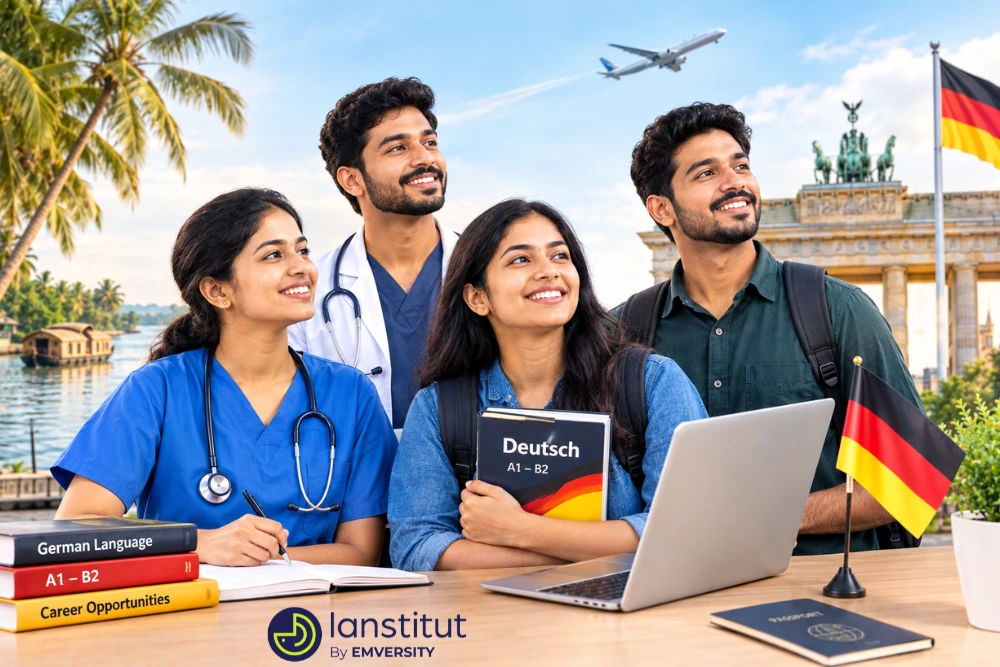
But today, some students and working professionals in Kerala are exploring another destination: Germany.
From nurses and healthcare professionals to engineers, IT specialists, and skilled workers, Germany is attracting people who want to build an international career. For many, the attraction goes beyond earning a salary. They are also interested in professional development, structured employment, social security, and the possibility of building a long-term future in Europe.
Kerala's own migration patterns reflect this broader interest in destinations outside the Gulf. The Kerala Development Report 2026 identifies a shift towards Western countries, particularly among people working in healthcare and knowledge-based industries, while also noting that the Gulf remains the main destination for Malayali emigrants. Read the Kerala Development Report.
However, moving to Germany is not as simple as applying for a job and booking a flight. Candidates need the right qualifications, language skills, visa eligibility, and, in some professions, formal recognition of their qualifications.
So, why are more Keralites considering Germany, how does it compare with the Gulf, and what should you do if you want to work there?
Let's explore.
The Gulf has long been an important part of Kerala's employment and migration story. Many Malayalis have built successful careers in healthcare, construction, engineering, hospitality, retail, finance, and business across the region.
Germany is not replacing the Gulf for everyone. Instead, it is becoming another option for people whose qualifications and career goals match opportunities in Europe.
There are several reasons behind this interest.
Some professionals want to develop specialised skills, gain international work experience, and progress in their chosen occupations.
Germany has an established industrial economy, with opportunities across manufacturing, engineering, technology, healthcare, and other skilled fields. The German Federal Employment Agency has also highlighted the growing role of international workers in supporting the country's labour market as its population ages. Source: Federal Employment Agency of Germany.
For a qualified professional from Kerala, Germany may offer a suitable career path if their experience matches employer requirements.
Germany has a social security system that includes areas such as health insurance, pensions, and unemployment insurance, subject to the applicable rules and eligibility conditions.
These arrangements can be attractive to people who want more than a monthly salary. They may also want access to healthcare coverage, retirement provisions, and other employment-related protections.
However, the benefits available to an individual depend on their employment status, insurance arrangements, residence situation, and applicable laws.
Germany's demand for workers varies by occupation, region, and qualification level.
Healthcare professionals are one important example. The German Federal Employment Agency and GIZ operate the Triple Win programme, which supports the recruitment of qualified nurses from selected countries, including India, through an organised process. Kerala nurses participating in the programme receive language and professional preparation and support with their transition to Germany. Source: Federal Employment Agency — Triple Win India (Kerala).
For candidates with suitable qualifications, experience, and language skills, Germany can therefore be worth exploring.
Germany and the Gulf countries can both offer valuable international career opportunities. But they are not the same, and the better choice depends on your profession, financial goals, family situation, and long-term plans.
Factor
Germany
Gulf countries
Main attraction
Skilled careers, professional development, and long-term settlement options for eligible applicants
Employment opportunities across many sectors and proximity to Kerala
Language
German is important for many jobs and everyday activities; requirements vary by role
Requirements vary by country, employer, and occupation; English is used in many workplaces
Healthcare careers
Professional recognition and German-language requirements may apply
Licensing requirements vary by country and healthcare regulator
Work opportunities
Depend on qualifications, employer demand, experience, and eligibility
Depend on employer demand, qualifications, experience, and local rules
Family life
Residence and family reunification options depend on the relevant rules
Family residence arrangements depend on the country and visa category
Long-term residence
Permanent residence may be possible for eligible applicants who meet the relevant conditions
Residence and long-term settlement rules differ across Gulf countries
Preparation
May require German classes, qualification recognition, documents, and visa preparation
May require licensing, document verification, employer sponsorship, and other country-specific procedures
This comparison is a general guide, not a guarantee of outcomes in either destination.
A professional who wants to save money and remain close to family may prefer a Gulf opportunity. Someone who wants to pursue a specific career path in Germany and is prepared to learn German may decide to explore Europe.
The right destination is the one that matches your qualifications, priorities, and realistic opportunities—not simply the one that is trending.
Healthcare is one of the clearest examples of the interest in Germany.
Kerala has a strong nursing education sector and a long history of international nursing migration. Germany is one of the destinations being explored by qualified nurses who want to continue their careers abroad.
The Triple Win programme, run by Germany's Federal Employment Agency and GIZ in cooperation with Indian partners, is one established route for eligible nurses. It includes language and professional preparation and support for the transition into the German healthcare system. Source: Federal Employment Agency — Triple Win.
Nurses may be interested in:
These are potential advantages, not guaranteed outcomes for every nurse.
A nursing qualification alone may not be enough.
Depending on the route, applicants may need to prepare:
Germany treats nursing as a regulated profession. Foreign-trained nurses generally need their qualifications recognised and must meet the applicable professional and language requirements before they can work as fully recognised nurses.
The precise requirements depend on the relevant authority and the applicant's circumstances.
Nurses need to communicate clearly with patients, families, colleagues, and other healthcare professionals.
They must understand instructions, explain care procedures, document information, and respond to questions. In this environment, language skills are about patient safety as well as employment.
For nurses from Kerala, learning German before moving can make the transition more manageable and help prepare them for the language requirements of their intended route.
Although nursing is an important pathway, Germany is also worth exploring for people in other skilled professions.
Germany has established engineering and manufacturing industries. Depending on the role, opportunities may exist in mechanical engineering, electrical engineering, automotive technology, industrial production, and related fields.
Candidates should check whether their degree, technical experience, and specialisation match the job requirements.
Software development, IT infrastructure, cybersecurity, data-related roles, and other technology occupations may offer opportunities for qualified candidates.
Some IT positions use English as the working language, but this depends on the employer and role. German can still be valuable for workplace communication, everyday life, and broader career opportunities.
Physiotherapists and other healthcare professionals may explore Germany if their qualifications and experience match the relevant requirements.
However, regulated healthcare professions can involve recognition procedures, language requirements, and additional steps before an applicant is authorised to practise.
People with relevant technical training or experience may also explore opportunities in areas such as electrical work, industrial maintenance, and other skilled occupations.
Eligibility depends on the specific job, qualifications, employer, and immigration route.
Before starting your German course, identify the profession you want to pursue and check its actual requirements. That will help you choose the right language target and prepare the necessary documents.
For many Keralites, learning German is the biggest adjustment when comparing Germany with destinations where they can already communicate comfortably in English.
German can take time to learn, especially if you are starting from the beginning while managing work or studies.
But it is an important part of preparing for life in Germany.
The German Federal Employment Agency explains that language skills can improve job prospects and are important for everyday activities such as socialising, finding accommodation, and communicating with authorities. Some regulated professions also have specific language requirements. Source: Federal Employment Agency — German language skills.
German courses commonly follow the Common European Framework of Reference for Languages (CEFR).
Level
What you learn
Practical goal
A1
Basic vocabulary, introductions, and simple sentences
Communicate in very familiar situations
A2
Everyday conversations and common expressions
Handle simple routine interactions
B1
More independent communication and familiar topics
Explain experiences, plans, and opinions
B2
More detailed communication and complex topics
Communicate with greater confidence in demanding situations
These levels describe language ability. They do not automatically determine whether someone qualifies for a particular job or visa.
There is no single German level required for every occupation.
Some employers may accept candidates with basic German, while regulated professions can have specific language requirements. Healthcare roles often require more substantial language preparation.
For example, a nurse may need to meet a specified German-language standard as part of the recognition process. A software developer applying for an English-speaking position may face different requirements.
Before choosing a course, check the requirements for your intended profession, employer, and visa or recognition route.
The time needed to learn German depends on your starting point, study routine, learning method, and the level you want to achieve.
A learner who attends classes regularly, completes homework, practises speaking, and revises lessons consistently may progress differently from someone who studies only occasionally.
A typical learning journey looks like this:
A1 → A2 → B1 → B2
Each stage develops additional vocabulary, grammar, listening, reading, writing, and speaking skills.
If you are working full-time, consider a realistic timetable rather than expecting to become fluent in a few weeks.
You can make use of short daily sessions by:
Regular practice outside class is important because attending lessons alone may not be enough to build strong communication skills.
Moving to Germany requires more than learning the language. The process depends on your occupation, qualifications, job offer, and the immigration route you choose.
A general preparation roadmap is outlined below.
Decide whether you are exploring Germany for nursing, engineering, IT, physiotherapy, vocational training, or another occupation.
Your intended profession will influence the documents, language level, and immigration options you need to investigate.
Find out whether your qualification is recognised in Germany or whether you need a recognition or comparability procedure.
This is especially important for regulated professions.
Check whether your intended route requires A2, B1, B2, or another specified standard.
Do not assume that the same level applies to all jobs or visa categories.
Choose a learning plan that covers grammar, vocabulary, speaking, listening, reading, and writing.
If an official language certificate is required, prepare for the relevant examination and confirm which certificates are accepted for your route.
Depending on your circumstances, you may need:
Look for legitimate employers, official recruitment programmes, and opportunities that match your qualifications.
Check employment conditions carefully and verify any agency or intermediary involved.
Germany has different immigration routes for different situations. Check the current official requirements before submitting an application.
An application is not guaranteed to be approved simply because a candidate has a job offer or a language certificate.
For reliable information, start with the German government's official Make it in Germany portal.
In some circumstances, yes—but it depends on the route and occupation.
Certain international companies hire people for roles where English is the primary working language. Some immigration routes also have different language rules.
However, it would be a mistake to assume that German is unnecessary just because a job advertisement is in English.
German can be important for:
For nurses and other regulated healthcare professionals, specific language requirements may apply.
If Germany is your long-term goal, learning German is a practical investment even when your initial job search focuses on English-speaking roles.
This is one of the most common questions among people planning to work abroad.
The honest answer is that it depends on the job and the individual's financial situation.
A salary comparison alone does not provide the full picture.
You should also consider:
In Germany, gross salary and take-home salary can differ significantly because of taxes and social contributions. Living costs also vary by city.
In the Gulf, the financial outcome depends on the employer's salary package, accommodation arrangements, insurance, transport, and other benefits.
A useful approach is to compare expected monthly savings, not just the advertised salary.
Before accepting an offer, ask for written details of the salary, working hours, deductions, accommodation, insurance, and other contractual conditions.
Some people consider Germany because they want to build a long-term future rather than work abroad for only a few years.
Germany has residence routes that may allow eligible workers to stay longer and, if they meet the relevant conditions, apply for permanent residence.
Family reunification may also be possible for eligible residents, subject to the rules applicable to their status.
However, these outcomes are not automatic.
The requirements can depend on the type of residence permit, employment, income, language ability, pension contributions, length of residence, and other legal conditions.
Anyone making a decision based on family settlement or permanent residence should check the official rules for their specific route rather than relying on general claims.
Germany can offer opportunities, but it is important to understand the challenges before making a commitment.
German requires regular practice. Grammar, word order, articles, cases, and pronunciation may take time to understand.
You may also need to use German in professional situations, not only everyday conversations.
Workplace communication, social customs, public services, and daily routines may differ from what you are used to in Kerala.
Learning about these differences before moving can help you prepare.
Some professions require official assessment of foreign qualifications. This can involve documents, translations, additional training, examinations, or other steps, depending on the case.
You may need to budget for language training, examinations, document preparation, visa-related expenses, travel, accommodation, and initial living costs.
Language learning, document preparation, job applications, and immigration procedures can take time.
A realistic plan is better than making decisions based on promises of immediate employment or guaranteed visas.
If you are still studying or have recently completed your qualification, you can begin preparing before applying for jobs abroad.
Focus on completing your qualification and gaining the relevant clinical experience. Research German-language and recognition requirements for the nursing pathway you want to pursue.
Build technical skills, gain relevant experience, and investigate employers in your field. Learn German alongside your academic or professional preparation.
Develop practical technical skills and build a portfolio or relevant work experience. Check whether your target employers require German or primarily use English.
Start by learning the basics of German and understanding the different career pathways. You do not need to decide everything immediately, but early preparation can give you more time to develop your skills.
In every case, your language course should support your career plan rather than replace the qualifications and experience your chosen profession requires.
For people in Kerala who want to explore Germany as a career destination, German-language training can be an important part of the preparation process.
Lanstitut offers German-language learning for students and professionals working towards different levels, from A1 to higher levels, depending on the course and learning plan.
A structured course can help learners develop:
If you are a nurse, engineer, IT professional, student, or working professional, begin by identifying the language level required for your intended pathway.
You should also research qualification recognition, experience requirements, visa rules, and job opportunities before making major financial or career decisions.
Lanstitut is a language training institute, not a recruitment agency. Language training can support your preparation, but it does not guarantee a job, placement, visa approval, or professional recognition.
If Germany is part of your future career plan, start by building the language skills you need and understanding the pathway that applies to you.
Some Keralites are exploring Germany for skilled career opportunities, professional development, social security, and possible long-term residence options. However, the Gulf remains an important employment destination for Malayalis, and the best choice depends on individual circumstances.
Germany may be an option for suitably qualified nurses who meet the language, qualification recognition, employment, and immigration requirements. Nurses should verify the current rules for their intended route.
The answer depends on your job and immigration route. Some positions use English, but German is important for many jobs, everyday communication, and regulated professions.
There is no single level for all jobs. Requirements depend on the occupation, employer, professional recognition process, and visa route. Check the relevant official requirements before enrolling in a course.
It may be possible, but BSc Nursing alone does not guarantee eligibility. You may need relevant experience, German-language skills, qualification recognition, a suitable job offer or programme route, and the appropriate visa.
Yes, qualified professionals may explore opportunities in these sectors. Eligibility depends on the role, qualifications, experience, employer requirements, and immigration route. German may be required or beneficial depending on the position.
Living costs and financial outcomes vary by city, salary, employer benefits, and personal circumstances. Compare take-home income, rent, insurance, taxes, and expected monthly savings before deciding.
The duration depends on your starting level, study time, learning method, and target level. Learners should set a realistic timetable and check the language requirement for their specific profession.
No. German skills can help with communication and may be a requirement for some pathways, but employment and visa decisions depend on the relevant eligibility rules and the applicant's complete profile.
Start with the official Make it in Germany website and the relevant German government or professional recognition authority. Nurses can also research official programmes such as Triple Win, where applicable.
Germany is becoming an option worth exploring for some Keralites who want to develop their careers abroad. Healthcare professionals, engineers, IT specialists, and other skilled workers may find opportunities that match their qualifications and long-term goals.
But Germany is not automatically better than the Gulf, and moving there requires preparation.
You need to understand your career pathway, develop the necessary language skills, check qualification recognition requirements, prepare your documents, and follow the appropriate immigration process.
For many candidates, learning German is one of the first practical steps.
Start with a clear goal, follow a structured learning plan, and research your intended profession before making decisions about moving abroad.
Your international career journey begins with preparation—not promises.